Your Next Customer Is Asking Reddit for Help Right Now
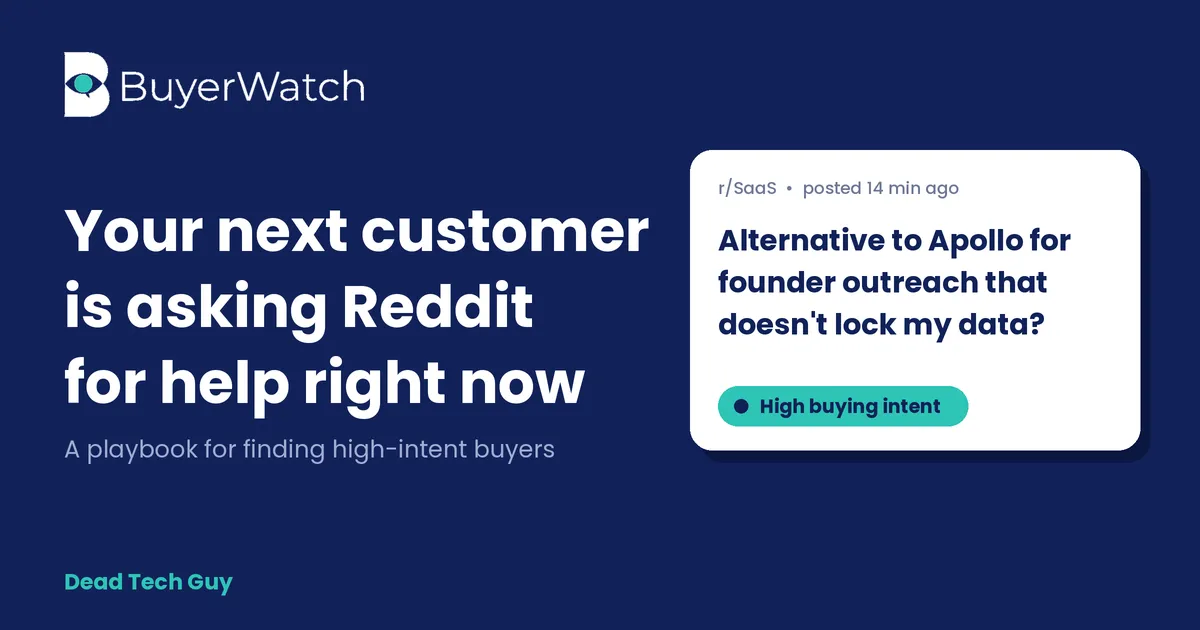
My younger brother built a tool that finds them. Here’s what I learned about how it works, and how anyone can use the same playbook.
Full disclosure first: I’m not an impartial reviewer. My younger brother, Abhishek, built BuyerWatch, and I’m writing this because he asked me to look at it. I don’t come from a sales background. I write about tech. So I went in curious, and honestly a bit skeptical.
What I found is a useful idea for any business that sells to other businesses, whether or not you ever use his product.
The idea: buyers announce themselves
Most marketing interrupts people. An ad shows up while someone is trying to do something else.
Reddit works differently. People go there to say exactly what’s bothering them, and often to ask strangers what to buy. Abhishek’s example is a post like: “What CRM are you using now that HubSpot increased tier prices 40%?” That person isn’t casually browsing. They have a problem, they probably have a budget, and they’re asking for an answer right now.
Four kinds of posts worth paying attention to
Not every mention of your industry is a lead. Abhishek’s playbook sorts the useful posts into four types:
- Direct tool replacement. Someone already pays for a product and wants out. “Alternative to Apollo for outreach that doesn’t lock data?”
- Acute workflow friction. Someone is describing painful manual work. “I spend 3 hours every morning scanning subreddits for client mentions…”
- Budget and pricing frustration. A price change has made someone angry. “Looking for a lightweight email verifier that isn’t charging $250/mo minimum…”
- Stack comparison. Someone is choosing between a few shortlisted vendors. “Has anyone compared Brand24 vs Mention vs newer AI intent tools?”
Once you see these patterns, you start spotting them everywhere. Type 4 is the closest to a purchase decision. Type 2 is the earliest, and often the best chance to help someone before they’ve picked anything.
Where to look
Skip the huge general subreddits. The buying conversations happen in smaller professional communities, such as:
- r/SaaS: founders and operators asking “what tool do you use for X?”
- r/startups: early-stage founders setting up their stack
- r/sales: sales reps and managers complaining about CRMs and data quality
- r/marketing: growth and demand-gen people evaluating analytics and listening tools
- r/sysadmin: IT leads comparing enterprise tools
How to reply without getting banned
This is the part I found most valuable, because it’s where most businesses go wrong. Abhishek’s claim is that most founders who try Reddit marketing get banned within days for dropping raw links. I can’t verify the exact number, but anyone who has spent time on Reddit knows the culture punishes drive-by promotion hard.
His approach has two layers.
Build a credible account first.
- Follow an 80/20 rule. Eight out of ten comments should be pure help with no product mention.
- Use an account that’s at least a few months old and has real comment history.
- Always disclose your affiliation. “Full disclosure: I built this” earns more trust than hiding it.
Reply in four parts:
- Acknowledge the specific problem, so the poster knows you read what they wrote.
- Give something useful for free, a tip they can use even if they never buy from you.
- Mention your product as one option, not the only answer.
- End with a question, not a signup link.
Here’s the contrast from his post. Someone on r/SaaS asked how to find beta testers without cold emailing.
The bad reply: “Check out our tool! Sign up here for a free trial!”
The good reply explains why cold DMs have stopped working, gives a manual search tactic the person can use immediately, mentions the tool briefly and openly, and asks what niche the beta is in. Same product, completely different result. One reads as a bot. The other reads as a person.
One caution from me, not Abhishek: every subreddit has its own self-promotion rules, so read them before you post anywhere.
The problem with doing this by hand
This works, but it’s slow. Abhishek estimates manual monitoring costs hours per day, and by the time you find a good thread it may be half a day old with dozens of replies buried above yours.
That’s the gap BuyerWatch fills. From what I can tell, it does four things:
- Scans Reddit, Bluesky, and X for your chosen keywords every few minutes
- Uses AI to throw out spam, job posts, and idle chatter
- Drafts a reply for the posts that look like real buying intent
- Leaves you to review, edit, and approve everything before it’s posted
That last point is what I like most. Nothing goes out on autopilot, so a human still owns every reply.
Who this is for
If you sell software or services to other businesses, and your customers ever ask for recommendations online, this playbook is worth trying, even manually with Reddit’s search bar. If you’d rather not spend your mornings scrolling, that’s what the tool is for. At the time of writing it’s $29/month with a 3-day money-back guarantee, but check the BuyerWatch site for current pricing.
You can read Abhishek’s full write-up and try BuyerWatch. And yes, I’m biased. He’s my brother. But I’d have written the same thing if he weren’t.